 Nick Welch |
Nick Welch is Senior Technical Development Executive for RTITB, the largest forklift training accrediting body in the UK and Ireland, recognised by the HSE, HSA and HSENI.
Although specific training is required for reach truck operators, in some operations, the particular risks and challenges of reach trucks may be misunderstood and overlooked. Often operators and supervisors assume that they're the same or similar.
Here are seven essential reach truck training considerations for employers.
1. Different Truck Categories
Reach trucks come in various categories, so different skills and training are required for safe and efficient operation. Many employers mistakenly think that operators trained to operate one type of reach truck are automatically qualified to operate them all. However, operators must complete conversion training to gain the competence and qualifications to operate different truck categories, such as seated or standing truck categories, or truck categories with a greater lift height.
2. Working at Height
Racking systems in reach truck operations are different to those encountered by counterbalance forklift operators. With increased racking height comes increased risk so operators must receive training that equips them to operate safely at height, with accuracy, efficiency and an understanding of the specific risks posed by drive-through and drive-in racking systems.
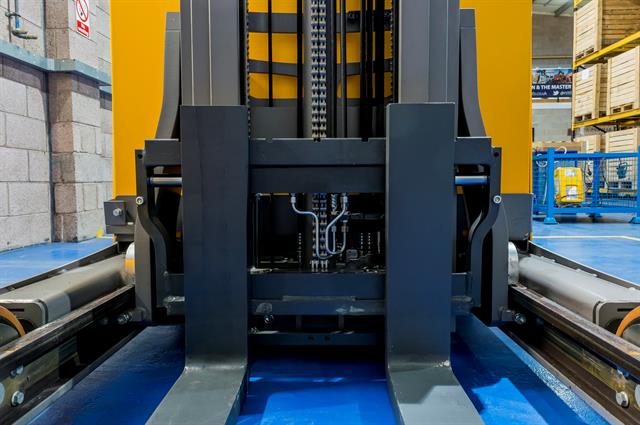 Reach trucks come in various categories |
3. Travelling on Inclines
Although it's not commonplace and should be avoided wherever possible, travelling on inclines can pose the biggest risk for reach truck operations. Operators must be trained accordingly on safe methods of negotiating an incline, with consideration of the drive and braking systems specific to reach trucks.
Correctly trained operators must be able to recognise the risks relating to negotiating inclines and demonstrate competence in negotiating inclines with a laden and unladen truck.
4. Assistive Technology
Assistive technologies such as cameras and LCD screens are increasingly common. Although this can be useful to enhance safety and efficiency, it should never take the place of the right reach truck training.
Devices designed to aid stacking and destacking should only be used to assist, and not relied upon. If the technology fails for some reason, the operator must be competent to operate safely without it.
5. Stability
The stability and centre of gravity of a reach truck differs to a counterbalance truck because they are designed to reach out towards the racking further than their stabilising legs.
To avoid a potentially fatal truck tip-over, operators must be trained to understand the truck's centre of gravity, load capacity, and the effects that load weight has on the truck when at height or with the reach extended.
6. Steering and Operating Position
Unlike a counterbalance truck, the load on a reach truck is positioned to the right of the operator. All-round observation is important and reach truck operators must be taught to look in the direction of travel, remaining aware of additional blind spots. These can be caused by the load, operating positions and overhead guard. When travelling with the forks leading, the mast also creates an additional blind spot.
7. Reach Mechanisms and Reach-Legs
In every movement and operation, the reach-legs and reach mechanism, whether a moveable mast, pantograph or telescopic, must be considered. Operators must understand how all these mechanisms function differently.
In addition, the varying types of reach mechanism suit different types of operation. This makes specific job training and familiarisation training crucial once basic training has been completed.