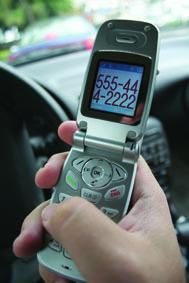
 Many countries and states outlaw the use of mobile phones while driving.
PHOTO: SHUTTERSTOCK |
Joseph Hrinik lives in Michigan (USA) where he retired after 40 years of diversified occupational health and safety experience in both the private and public sectors. He is currently researching regional and national forklift safety legislation and forklift training programs.
A recent thread in the
Forkliftaction.com Forums has been discussing the dangers of operators using mobile phones on forklifts. I believe this raises a safety issue that has not been sufficiently recognised nor addressed by employers, the forklift industry or the occupational safety profession.
Most readers are probably aware of the debate currently going on regarding driving vehicles on public roads while talking on cell phones. Many countries have banned this activity. Examples include Australia, Germany, Japan, Spain, the UK and many other countries. The US and Canada have been much slower in addressing this issue. The majority of the states, provinces, territories have not yet banned such practice. This
website contains a list of countries that ban cell phone use while driving.
When using a mobile phone while driving, two hazard factors apply. The first is reduced tactile dexterity. Some actions require or are safer using both hands. These include making a turn, steering while changing gears or steering while sounding a horn or other warning device. Performing such actions can be clumsy and restrictive while holding a phone in one hand.
I'm sure we have all been at a traffic light and observed a person talking on a hand-held cell phone making a turn. They're talking away and suddenly their arm is in an awkward position to continue turning. They take their hand completely off the steering wheel and reposition the hand and continue turning. This may happen several times. In the meantime, the vehicle swerves slightly off course during each free-wheeling interval. Often I have wondered whether the driver would complete the turn or crash into something. When the driver doesn't crash, he/she simply drives away oblivious to his/her surroundings with the mobile phone still held against his/her ear.
Hands-free cell phones may help eliminate the tactile dexterity problem. They offer no relief, however, for the second hazard factor which poses an even greater accident risk.
The second hazard factor is driver distraction. Attention becomes so focused during a phone conversation that the real surroundings take on a subdued perspective. Reactions to real-time situations slow or are delayed. Braking is at a slow relaxed pace when greater braking performance may be required. Drivers may suddenly turn into oncoming traffic or pull out into oncoming traffic to pass a vehicle. They are completely oblivious to oncoming traffic. They may be looking directly at the oncoming traffic but they do not see the oncoming traffic. This cognitive distraction occurs in both hand-held cell phone use and hands-free cell phone use. Conversations can also become very emotional which further increases driver distraction.
Traffic accident researchers are also finding that cell phone use is creating pedestrian distraction. Pedestrians using cell phones are casually stepping in front of oncoming traffic. Sometimes they look at the oncoming traffic and step out anyway. At other times, they merely step out without looking. In both cases, the cell phone-using pedestrians are not in tune with the hazards in their immediate environment.
Reduced tactile dexterity and driver distraction are even greater hazards in the forklift environment. A forklift does not handle like a car. It is also used in a more confined setting, often in very close proximity to pedestrians, other forklifts and expensive goods and property. The safe operation of a forklift requires constant forklift operator attention. There is little room for error on the part of the forklift operator.
Pedestrians, including workers, vendors, visitors (and in big box stores - customers) pose an even greater hazard if they are walking in forklift operating areas while talking on cell phones. The forklift operator should assume that these pedestrians can unknowingly do the unexpected at any time and should stop their forklift activity and yield to such pedestrians.
I am not aware of any OHS/OSH/OSHA regulations that prohibit cell phone use while operating a forklift, nor do I expect to see any such legislation in the near future.
What is currently needed is for employers to develop work policies regarding cell phone use in forklift operating areas; for forklift manufacturers to incorporate cell phone hazards and safeguards into their forklift operator/safety manuals; and for occupational safety professionals to educate managers, supervisors, and other employees in the hazards and safeguards of cell phone use.
Forklift operator instructors/trainers can greatly assist in this endeavour by covering mobile phone use hazards and safeguards in their forklift operator training programs. It is easier to create safe work habits with new operators than it is to try to change bad habits of experienced operators.
Two industry best practices that could be developed include:
1) A forklift is not to be operated while the forklift operator is talking on a cell phone. If communication is necessary, the forklift operator must first stop forklift travel in a safe location, shift the forklift into neutral, apply the parking brake and lower the load to floor level.
2) Persons working in environments where forklifts are being operated can only use cell phones from a safe stationary position. Persons walking in forklift travel aisles and other forklift travel areas are prohibited from talking on cell phones.
I am using mandatory wording in these practices as I feel such actions should not be optional on the part of the operator or the employer. Stopping the forklift to talk with only the normal brake engaged is not sufficient as the driver could accidentally let up on the brake while distracted in cell phone conversation. The forklift operator could also accidentally tip the load forward while distracted in cell phone conversation. This is the reason the load should be fully lowered.
The industry best practices should also be deliberately extended to include other forklift operator tactile dexterity limitations and driver distractions. These could include eating, drinking, smoking, operating computers and other electronic aids, operating two way radios, reading paperwork or filling out paperwork, etc. I'm sure you can add many additional items that should be addressed.
Help spread the word that limited dexterity and driver distractions, especially from cell phone use, can be hazardous to all.
What do you think? And if the arguments above are not enough to convince you, consider that mobile phones are not to be used in potentially explosive atmospheres as they are not intrinsically safe. Sparks from the internal high power cell phone battery can trigger an explosion. Cell phones are not to be used in forklift battery charging/changing areas or forklift fueling areas.