
Exclusion zones and pedestrian safety

Darren Cottingham -
Safety First
- 31 Oct 2019 ( #947 )
2 min read
Darren Cottingham
Darren Cottingham
Darren Cottingham is director of DT Driver Training, a provider of online training courses for drivers of forklifts, trucks and cars.
Painted walkways, cones and barriers are obvious delineations in the forklift vs pedestrian equation, but it's extremely difficult to separate human/forklift interactions in all situations.

Distance between the two is the foundation for safety when pedestrians and forklifts operate in the same area.

You may have heard the term 'exclusion zone'. It has two meanings: either an area designated only for forklifts or an area around a forklift whereby if any person is in it, the forklift should be made safe. The size of the exclusion zone is related to the size of the forklift. For most small forklifts and reach trucks, 3 m is a good start, but for larger forklifts and container handlers, choose a distance which is a bit more than the radius of the turning circle of the forklift. For example, a container handler could have a turning radius of around 6-7 m. Picking a distance greater than the turning radius means that even if the forklift pivots on its driving axis, the rear end swing will not endanger anyone outside the exclusion zone.
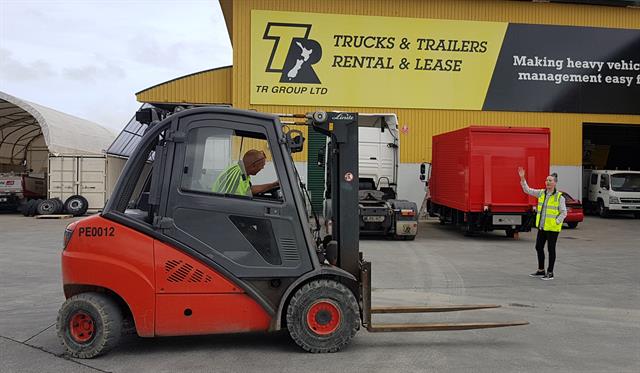
The pedestrian and operator should attract each other's attention
So, how does a pedestrian enter an exclusion zone and what should the operator do?

The pedestrian and operator should attract each other's attention verbally and/or by using eye contact and hand signals. Be aware of the potential for ambiguity; is that raised hand meant for someone over your shoulder?

The forklift operator should then bring the forklift to a stop, straightening the wheels. This is so that, in a moment of inattention during or after the communication, the operator doesn't drive forward with the result being the counterbalance swinging into the pedestrian standing next to the forklift. The operator should drop the forks to the floor, put the handbrake on and put it in neutral. Then the pedestrian can approach the forklift.

Once the operator and pedestrian have finished their communication, the pedestrian must exit the exclusion zone, then the operator is safe to move away. It's not recommended that a pedestrian talk to a forklift operator while they both continue moving, although there may be scenarios where this is required. The reason for this is that when we're talking to people we often look at them. If we're walking or driving at the same time, that means we're not looking where we're going.

Many newer forklifts come with either proximity detection systems which warn the operator or brake the forklift automatically, or lights which project an exclusion zone on the ground around the forklift. These systems can also be retrofitted to forklifts. If you have a scenario where pedestrians come into contact with your forklifts, those systems are an obvious health and safety choice, especially because humans are not good at judging distances.
Also Read:
Vehicle mounted terminals and private 5G/LTE is the next-gen wireless standard for security and performance
Tejal Ranjan
3 minute read
Vehicle mounted terminals and private 5G/LTE is the next-gen wireless standard for security and performance Your Focus - 4 Dec 2025 (#1259) Tejal Ranjan, vice president of global marketing at JLT Mobile Computers, looks at why private 5G and LTE will be standard for next-gen equipment
How positive friction prevents forklift accidents before they happen
Stuart Taylor
3 minute read
How positive friction prevents forklift accidents before they happen Safety First - 27 Nov 2025 (#1258) Stuart Taylor is managing director of Mentor FLT Training Limited looks at ways positive friction can be used to help prevent forklift accidents from happening
How advanced relay contact design transforms forklift reliability
Carlos Mendes
3 minute read
How advanced relay contact design transforms forklift reliability Your Focus - 20 Nov 2025 (#1257) Carlos Mendes is a product manager for switching at Durakool, working closely with engineers and buyers to bridge the gap between application and specification.
For more unique stories and expert insights: read our industry blogs
Blog articles provide perspectives and opinions and therefore may contain inaccurate or incomplete information. Forkliftaction Media accepts no responsibility for errors or omissions. If you feel that significant facts are overlooked, or have a different viewpoint on a topic addressed, we invite you to open a conversation in our Discussion Forums.

Are you recruiting? Find your ideal candidate among a diverse range of materials handling professionals:

Forkliftaction's JOB MARKET

Inside The News
In this week’s Forkliftaction News , we look at the November Logistics Manager’s Index which has dropped to the lowest it has been since June 2024... Continue reading

PREMIUM business

Hangzhou Maxlion Machinery Equipment Co., Ltd
3G Standard, Good Products, Good Price, Good Service.
Upcoming industry events …
February 24, 2026 - Panama City, Panama
April 8-10, 2026 - Jiangsu Province, China
June 10-11, 2026 - Cologne, Germany
Editorial calendar - planned features
CONSTRUCTION FORKLIFTS
HANDLING GOODS IN THE COLD
LOADING/UNLOADING FREIGHT
BROWNFIELD AUTOMATION
FORKLIFT ATTACHMENTS
BATTERY AFFORDABILITY AND LIFETIME
FORKLIFT SAFETY
Upcoming industry events …
February 24, 2026 - Panama City, Panama
April 8-10, 2026 - Jiangsu Province, China
June 10-11, 2026 - Cologne, Germany
Inside The News
In this week’s Forkliftaction News , we look at the November Logistics Manager’s Index which has dropped to the lowest it has been since June 2024... Continue reading

PREMIUM business

Hangzhou Maxlion Machinery Equipment Co., Ltd
3G Standard, Good Products, Good Price, Good Service.